The Road to Anywhere
It was during a disorienting phase of transition that WHT led me to an excerpt from David Goodhart’s The Road to Somewhere in our first Moral Philosophy seminar. I had arrived in Oxford just two days earlier. Most of that time was spent sleeping away my worries within the quiet confines of my room at Trinity College. Outside, time and space felt strangely warped. I had imagined that Oxford’s archaic buildings and lanes would fascinate me—but instead, I felt intimidated and alienated, as though I’d been air-dropped into a world where I was expected to thrive instantly. Even the modest five-hour time difference with home felt insurmountable. I hadn’t made new friends yet, and I was struggling to keep up with those back home. In that moment, Goodhart’s reading felt timely. The WHT team wanted us to reflect on globalism and ask ourselves: do we feel like we belong “somewhere” in the world or “anywhere”?
As a student at an elite institution, Goodhart would likely have classified me as a textbook “Anywhere”—a liberal individualist, globally mobile and rootless—rather than a “Somewhere,” rooted in place and tradition. I hoped that was true. But in those early days of longing for home, I found myself thinking like a “Somewhere”: someone who drew strength from immediate community and familiar surroundings.
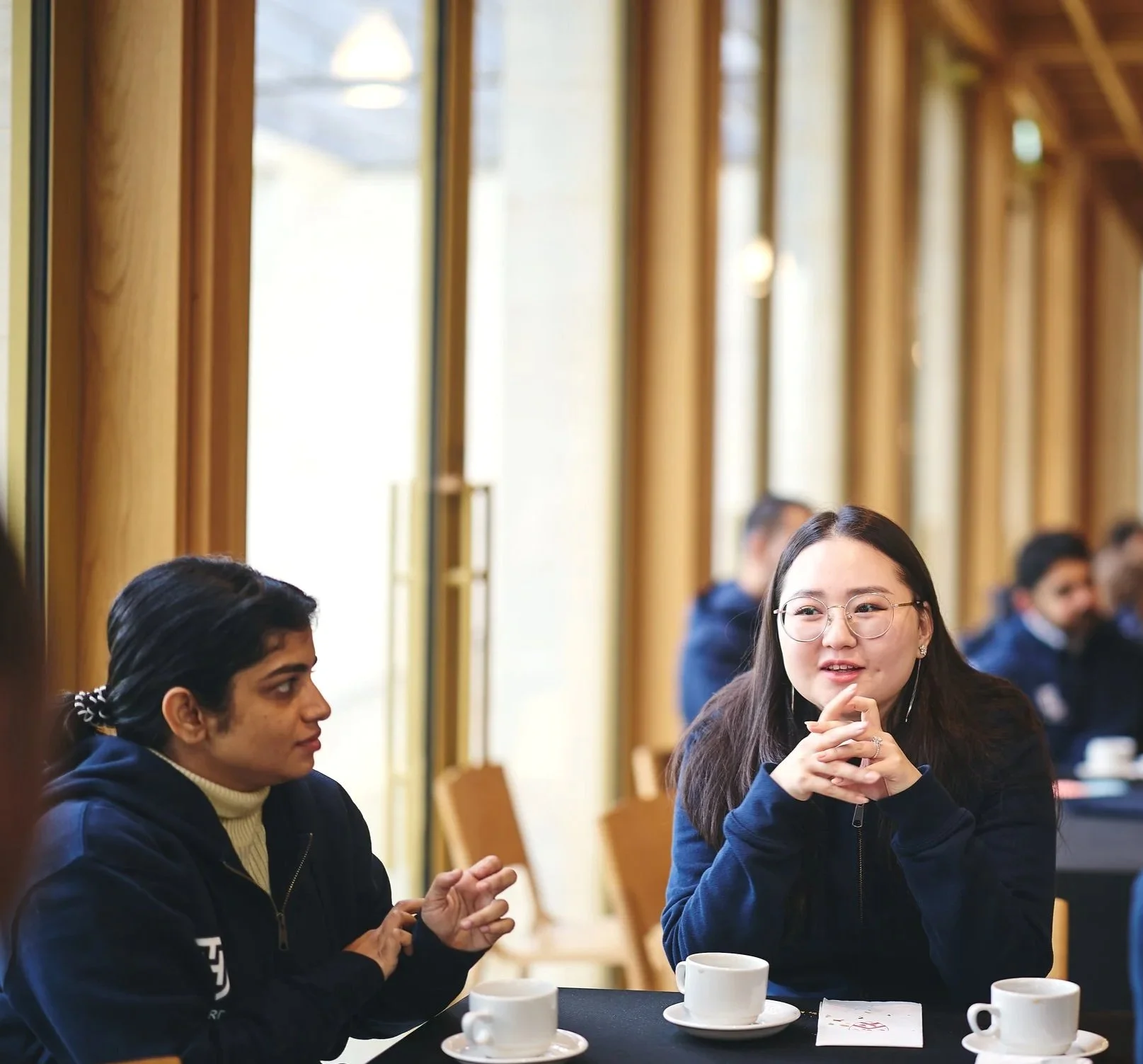
Teres Vattoly (on the left) during a moral philosophy session
Back home in India, I had confidently imagined myself as an “Anywhere.” I spoke English, consumed the same pop culture as much of the West, and had always assumed I’d adjust easily to life abroad. But the reality in Oxford felt different. In those early days, I felt more Indian than I ever had before. I clung more tightly to the aspects of my identity that rooted me. They made me feel more like myself in a space that felt foreign. And yet, I was embarrassed by this contradiction. According to Goodhart’s framework, I should have been an “Anywhere.” But I didn’t feel like one.
The following day, in a seminar room at Worcester College—arguably one of the most beautiful colleges in Oxford—I found comfort in learning that I wasn’t alone. Many of my WHT peers felt the same contradiction. Uprooted from our usual lives, many of us found ourselves leaning toward being “Somewheres” more than we expected. We also agreed that these labels weren’t binary. We all carry both impulses within us: the desire for rootedness, and the pull of mobility. Still, I hoped I would grow into more of an “Anywhere” over time—that I would learn to embrace the world beyond my immediate surroundings.
Looking back, I think I did.
Formal and informal conversations between scholars opened up my world. Between Sinnah’s and David’s debates on which African country has better food, I learnt much more than just the culinary differences. I learnt about the energy crisis, the shortcomings of health infrastructure, and tokenistic female representation in politics. Scholars from Ukraine and Palestine brought distant conflicts closer to home. Over hotpots with Southeast Asian friends, I learnt about the politics of education in Vietnam and the political trajectory of Myanmar. Scholars from South America showed me breathtaking locations in their countries, while we also discussed drug wars and social inequality. While I had read about these issues before, listening to lived experiences made these realities more vivid and immediate.

WHT scholars debate team 2024-2025
Living in Oxford also pushed me to shed some of the assumptions I had lived with. As a woman in India, I had spent much of my life managing safety—carrying pepper spray, avoiding going out at certain hours, always being alert. In Oxford, that burden lifted. For the first time, I could imagine a life without that constant vigilance. I also discovered unexpected joy in the physically active lifestyle that Oxford encourages—walking everywhere, cycling, swimming in lakes, being outdoors. This shift influenced my academic interests too. It led me to study access to public spaces in India for my thesis and advocate for more inclusive urban planning.
Now, I’m writing this from the terrace of my new home in a hutong in China, as I work for a multilateral development bank. In this world, conversations revolve around countries as units. I don’t think I could have entered a space like this so confidently if not for all the experiences that came before.
Oxford took me closer to my dream of becoming an “Anywhere”—as I prepare to contribute to my “Somewhere.”
“And it’s a little difficult, but it’s very valuable to be forced to move from one place to another and deal with another set of situations and accept that this is going to be — in fact it is — your life. And to use it means that you, in a sense, become neither white nor black.” — James Baldwin