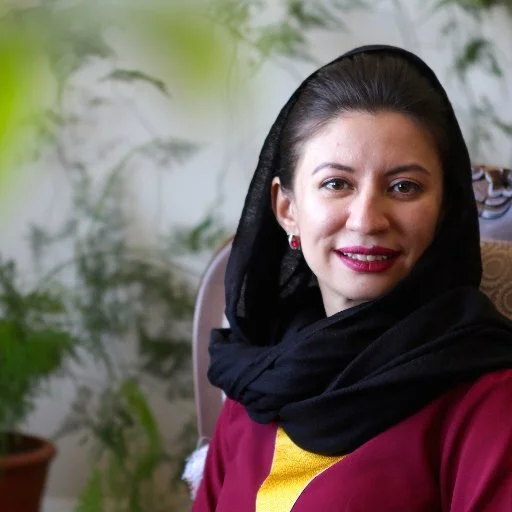
Shaharzad Akbar: Afghan Human Rights Leader
Shaharzad Akbar is an Afghan human rights defender whose work centres on documenting violations, amplifying local voices, and mobilising action for accountability. She serves as Executive Director of Rawadari, an Afghan human rights organisation she helped establish following the fall of Kabul. Rawadari is a civil society organisation dedicated to monitoring and advocating for the rights of Afghans, with a focus on women, girls, and marginalised communities. Now in exile, Shaharzad continues her advocacy on the global stage and serves as a Visiting Scholar at Wolfson College, University of Oxford. Her writing has appeared in international outlets including The Washington Post, Foreign Affairs, and Al Jazeera, reflecting her work on human rights, peace, and accountability for gross violations.
In 2023, she was invited to provide a civil society perspective and recommendations to the UN Security Council met, where she said,
We—the majority of Afghans—want an equal, peaceful and prosperous country. We want a country that is not at war with its women and girls. We want a country that embraces its rich ethnic, linguistic and religious diversity. And we want a country that respects the human rights of all Afghans... The choice before you is—will you support our vision of a peaceful, equal, diverse, democratic Afghanistan, or the Taliban’s vision, one that violates the UN Charter, and the fundamental values that this Council claims to uphold?
Previously, Shaharzad led the Afghanistan Independent Human Rights Commission, guiding the institution through a period of intense insecurity and political transition. Her professional experience spans civil society, media, and government, including roles as Country Director of Open Society Afghanistan and founder of a Kabul-based consultancy.
She is active globally as a speaker, writer, and advocate, engaging bodies such as the UN Security Council and Human Rights Council. Her commentary appears widely in Afghan and international outlets, and she sits on boards and advisory councils shaping human rights work worldwide.